|
| 第18期出刊日:2014.01.10 |
| 物理學系陳永芳教授研究成果分享 |
| 快閃式隨身碟便利貼:第一個可黏貼的記憶體誕生了 |
未來電子產品不像現今最新的智慧型手機、平板電腦、數位相機或其他電腦裝置一樣,像塊堅硬的金屬或是塑膠盒子。它們將極其輕、軟、可撓、透明並融入我們的日常用品,包含各式樣光電元件,乃至於紙、衣服、手套、尿布。如果你想體驗未來,想像一下電子皮膚、牙齒上的健康檢測, 或是直接植入器官中的感應薄膜。這些進階電子系統,把多種重要組件,例如邏輯和記憶體、電源供應器等,做在軟性基板上,而具備智慧功能。要達到上述目的,記憶體是不可或缺的要件,具簡單三明治結構的有機記憶體,因其特殊的優點,例如低製備成本、機械彈性、可撓、低製程溫度、滾筒式印刷的特性,而被認為有望成為未來軟性電子時代的資訊儲存元件。然而,到目前為止,可複寫的有機記憶體大多製作於堅硬、平坦、光滑的基板上,像是金屬、玻璃、塑膠、或矽基板上,這大大限制了它們優越的柔軟、可撓特性。由於有機薄膜的製備都是利用溶液製程¬¬──例如,旋轉塗佈或是噴墨印刷,在這過程中,把可撓的有機記憶體做成堆疊或是3D結構是一個很大的挑戰。原因在於,用於垂直整合的溶液製程會引起底部軟性有機元件或基板嚴重損壞。因此,在不同的基板或裝置上,建立一個合適的製備辦法製作可複寫有機記憶體,在未來的應用中是必要的。我們最新的研究中提出一種辦法可用於克服上述挑戰 (2013年10月18日的Advanced Functional Materials "Rewritable, Moldable, and Flexible Sticker-Type Organic Memory on Arbitrary Substrates" )。 我們成功演示了第一個在任意非典型的基板上的可複寫、轉移且可撓的有機記憶體便利貼,該記憶體可藉由一個簡單、低溫、成本低廉的步驟完成。
|
 |
(a)有機記憶體便利貼製作過程示意圖。
|
  |
  |
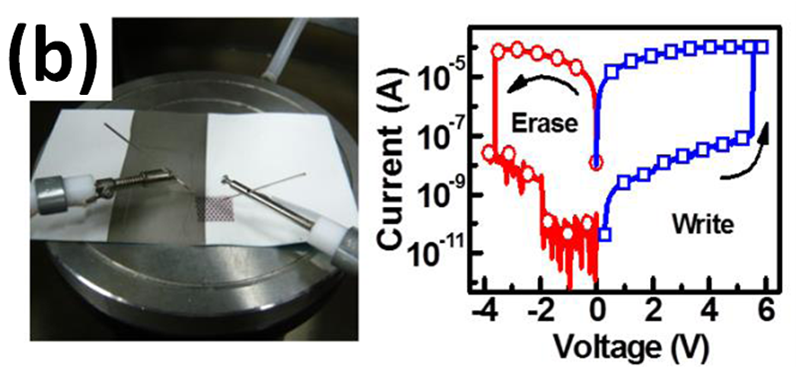
(b)記憶體貼在各種非典型基板上的照片及其I-V曲線,包含商務名片、
(c)人造指甲、(d)醫療腕帶、(e)可撥離的便利貼
|
此可複寫有機記憶體可以簡單黏貼在不同需求的基板上,包含堅硬、可撓、不平、粗糙等等物質,這大大的拓展了資訊儲存裝置在未來各種不同的應用。從幾個不同的方面來看,相較於有機雙穩態記憶體傳統的由下而上的溶液製程,我們的可轉移、可撓記憶體有幾個好處,其中最重要的是,有機記憶體具備可轉移且可自我黏貼的特性,使垂直整合其他可撓有機元件變得容易,並能使溶劑所引起之損壞問題最小化;因此,非傳統的基板上的嚴苛合成及非常規製程步驟都可以避免。第二, 有機記憶體層和石墨烯轉移保護層的整合,免除了石磨烯保護層化學處理的需求。由於底層是可撓且可黏貼石墨烯電極的關係,記憶體可以簡單的製成並運作在非典型材質上,包含不平或是軟性的基板,此多樣化的基板選擇特性,將大大拓展記憶體的應用層面。第三,考量成本效益問題,由於有機材料和底層化學氣相沉積(CVD)的石墨烯都能使用滾筒式製程,所以此種記憶體很適合工業大面積印刷製作。化學氣相沉積成長出的獨特極薄石墨烯在這項新奇的類標籤記憶體中具關鍵的導電材料。基於它良好的導電特性、機械彈性、低成本、可滾筒式製作的特色,我們選用它作為有機記憶體的導電層。利用其優異的機械性質和強力的界面吸附力,使化學氣相沉積成長的石墨烯成為一種可用來黏貼在非典型表面和可撓電子元件的理想界面電極。此外,極薄的特性能有效降低元件厚度,這對黏貼和彎曲的操作更為有利。
歸功於低製作成本、便利的加工方式、機械彈性及高速存取能力,可撓式記憶體在低功耗數位資訊儲存裝置如智慧型標籤、e-tag或可攜式硬碟的應用上也很有潛力。甚至於引入天線電路後,此記憶體可供無線存取。而且,由於是非揮發性記憶體,不須額外電力也能保留資料。
|
| |
Turning Post-it Notes into Flash Drives:
Creation of the First Sticky Memory |
Professor Yang-Fang Chen(陳永芳), Department of Physics
Future electronics will look nothing like today's rigid metal and plastic boxes, be they the latest smartphones, tablets, digital cameras or any other computer device. Instead, they will be extremely light, soft, flexible, transparent, and integrated into everyday objects like paper, clothes, leather gloves, diapers, or packaging material. If you want to go really futuristic, think electronic skin, health monitor tattoos on teeth, or sensor films placed directly onto internal organs.These advanced electronic systems will be fabricated on soft substrates by integrating multiple crucial components such as logic and memory devices as well as their power supply. Organic memory with a simple sandwich structure has been considered a promising information storage element in future soft electronics for its exceptional merits such as low production cost, mechanical elasticity, flexibility, low-temperature processing and roll-to-roll printability. However, so far, rewritable organic memories have been fabricated mostly on rigid, flat, and smooth substrates, such as metal, glass, plastic and silicon, which greatly limits their superior soft and flexible merits. Due to the fact that organic films are often fabricated by solution processes – i.e., spin-coating or ink-jet printing – there exists a great hurdle in constructing flexible organic memory in stack or 3D architecture. The reason for this is that the use of solution processes can result in severe damage to the bottom soft organic device or substrate arising from the solvent used for the vertical integration of the subsequent devices. Therefore, for future applications, it is essential to establish a proper fabrication strategy for rewritable organic memory onto diverse substrates or devices. In new work, we have reported a methodology to overcome the above-mentioned challenges. Reporting their work in the October 18, 2013 online edition of Advanced Functional Materials ("Rewritable, Moldable, and Flexible Sticker-Type Organic Memory on Arbitrary Substrates"), we have, for the first time, successfully demonstrated a rewritable, transferable, and flexible sticker-type organic memory on arbitrary nonconventional substrates through a simple, low-temperature and cost-effective one-step methodology.
|
|
(a) Schematic of the fabrication processes for the sticker-type organic memory.
|
|
|
(b) Demonstrations of the memory labelled onto various non-conventional substrates with the corresponding I-V curves alongside, including on business card.
(c) on fake nail. (d) on medical wristband. (e) on peelable Post-it Flag
|
We demonstrate that this re-writable organic memory can be simply stuck on various desired substrates, including rigid, flexible, non-planar, and rough substrates, and so forth, promising that the information storage devices can be greatly broadened in diversified future applications. "Compared to traditional bottom-up solution processes for organic bistable memory, the advantages of our transferable and flexible memory device include several unique aspects." Most importantly, the transferable and self-adhered features of the organic memory pave an easy route to vertically integrate digital organic memories with other flexible organic devices with minimal solvent issue; hence harsh synthesis and unaccustomed fabrication steps on non-conventional substrates can be avoided. "Secondly, the combination of organic memory and protective layer for transferring graphene electrode eliminated the need for chemical treatment processes for the graphene’s protective layer. With the flexible and adhesive graphene-electrode underlay, the presented memory can be simply molded and functioned on desired non-conventional substrates, including non-planar and soft ones. This versatile substrate selection advantage might greatly broaden memory applications. Thirdly, considering the cost-effective production and because both the organic materials and the bottom CVD-graphene possess the capability for roll-to-roll processes, the resulting memory is suitable for industrial large-area printing manufacture. CVD-grown graphene with a unique ultrathin feature is a crucial conductive material in this novel label-like memory.
Due to its good conductivity, mechanical flexibility together with low-cost and capability for roll-to-roll fabricating features, the researchers chose it as their flexible conductive layer for the organic memory. In particular, "utilization of its astonishing mechanical properties and strong attractive interfacial adhesion force make CVD-grown graphene an ideal interfacial electrode for adhering to non-conventional surfaces and flexible electronic applications. Moreover, its unique ultrathin characteristic can significantly reduce our device thickness, which is beneficial for adhesion and bending operation. "Thanks to its combination of low fabrication cost, facile processes, and mechanical flexibility combined with high-speed electrical access capability, application areas for this flexible memory could potentially be found in low-cost digital information storage area such as smart labels, e-tags, and portable disks. By introducing an antenna circuit it could be accessed wirelessly. Also, it is nonvolatile, which means it can keep the data without a battery. |
| |
 |
| |
|
|


