One of the major characteristics of summer-time convective systems over land is their strong response to diurnal forcing. Typically the response is conceptualized as a progression through distinct phases, including the development of the dry convective boundary layer, the emergence of shallow cumulus clouds, the transition from shallow to deep cumulus clouds, the meso-scale organizations of deep cumulus clouds and (at times) the subsequent evolution of such systems as they draw moist air from low-level jets riding over stable boundary layers. It is difficult for large-scale models to capture this diurnal cycle because it depends almost entirely on sub-grid scale parameterizations which uncertainly represent the underlying physical processes. Model studies (Bechtold et al. 2004; Guichard et al. 2004) show that the surface precipitation generally develops a couple hours earlier in the morning in single column model (SCM) representations of the diurnal cycle over land as compared to observations, as the SCM representations consistently bypass the shallow cumulus phase. These studies concluded that the most challenging part of modeling the diurnal cycle over land is to represent the development of shallow cumulus and the transition toward deep convection. In this study, we endeavor to understand this transition and the particular role of shallow convection.
To extract the essence of the transition from shallow to deep convection, we use an idealized framework to highlight the role of two control parameters, the free tropospheric lapse rate of potential temperature and the relative humidity (Fig.1). The systematic dependence of the development of convection on the potential temperature lapse rate and the humidity show that the concept of a convective transition is a meaningful one (Fig.2). A transition time can be defined to evaluate the relationship of the transition time to the evolution of the thermodynamic state of the different simulations.
The results show that the transition time depends on both the moisture and the potential temperature lapse rate, but in a way that previous ideas do not fully encapsulate. The shallow convection persists until the environment of the shallow cumulus layer becomes unstable to the average cloud properties as illustrated by the cartoon in Fig. 3. This permits the transition time to be predicted given a consideration of the stability of the shallow cumulus layer. By analyzing the time evolution of the lapse rate of virtual potential temperature of the environment and that of the clouds in the shallow cumulus layer, we show that the transition coincides with the time when the lapse rate of the clouds becomes larger than that of the environment, suggesting that transition happens when shallow clouds become, on average, buoyant (Wu et al. 2009).
We then construct a simple model which shows that the mean cloud properties can be usefully related to the mean environmental profiles. The geometric mixing model which assumes that the clouds consist of a uniformly distributed mixing fraction of air between the surface and the observed level in the Paluch diagram (Fig. 4) is used to represent the mean cloud properties. The overall behavior of the simple mixing model suggests that the time evolution of the cloud lapse rate in the shallow cumulus layer can be represented given knowledge of the surface and environmental properties. The results also suggest the importance of the shallow cumulus in preconditioning the environment for the development of the deep convection. While our experiments are constructed under conditions over the Amazon, the ideas we invoke are general and may be applicable to other circumstances (i.e. over the ocean or over drier land). Those ideas are readily testable with data. Thus, in addition to developing our understanding of how the representation of shallow convection affects the environmental stability, future work should focus on evaluating the extent to which processes we articulate here may be relevant to the diurnal evolution of clouds.
Reference
Bechtold, P., J.-P. Chaboureau, A. Beljaars, A. Betts, M. Kohler, M. Miller, and J.-L. Redelsperger, 2004: The simulation of the diurnal cycle of convective precipitation over land in a global model. Quart. J. Roy. Met. Soc., 139, 3119–3137.
Guichard, F., J. C. Petch, J.-L. Redelsperder, P. Bechtold, J.-P. Chaboureau, S. Cheinet, W. Grabowski, H. Grenier, C. G. Jones, M. Kohler, J.-M. Piriou, R. Tailleax, and M. Tomasini, 2004: Modeling the diurnal cycle of deep precipitating convection over land with cloud-resolving models and single-column models. Quart. J. Roy. Met. Soc., 130, 3139–3972.
Wu, C.-M., B. Stevens and A. Arakawa, 2009: What controls the transition from shallow to deep convection? J. Atmos. Sci., 66, 1793-1806.
|

Figure 1
The initial thermodynamics profiles for the Amazon sounding and the idealized experiments. The figure on the left presents the environmental stability (Γ) which is defined as dθ/dz. The figure on the right presents the environmental relative humidity.

Figure 2
The domain averaged and ensemble cloud condensate for all experiments. The contour interval is 0.01 g/kg.
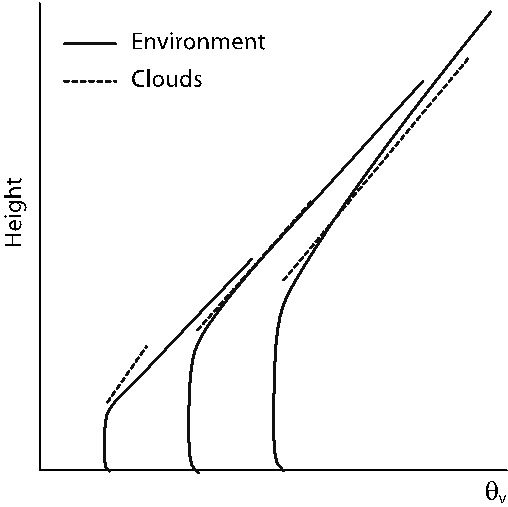
Figure 3
A schematic illustration of transition from shallow to deep convection. The thin solid, thick solid and dash lines represent the initial, environment, and cloud θv. The environment θv is averaged over the entire domain while the cloud θv is averaged over cloudy points only. The three sets of profiles represent the profiles before, during and after then transition.

Figure 4
The scatter plot of total water mixing ratio (qt) and the potential temperature (θl) of the cloudy points for experiment M85 before and after transition. The dotted line represents the line connecting the surface point and the observation level. The tick mark and the dot represent the mean properties of the mixing model and the clouds.
|


