Ramifications of short-term meteorological variability on elevational range size
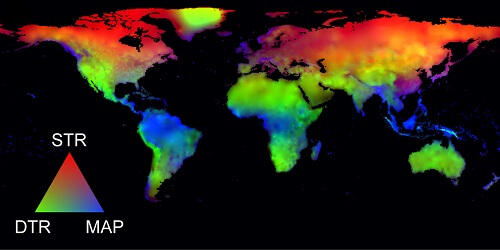
Spatial distributions of fauna are sensitive to climate variabilities. Classic ecological hypotheses have all suggested that greater seasonal climatic fluctuations will result in a wider species geographic distribution. These were proposed about a half century ago and have been heavily tested through the years. However, animals experience not only seasonal climatic but diurnal meteorological dynamics, and the latter one has rarely been addressed and investigated. A collaborative study led by Wei-Ping Chan and Sheng-Feng Shen of Academia Sinica, I-Ching Chen of National Cheng Kung University with Cho-ying Huang at National Taiwan University analyzed a global dataset of species distribution using new technologies to assess the influences of short-term physical environmental drivers to the elevational range sizes. Surprisingly, they found that, in general, species elevational range size is negatively correlated to diurnal temperature range, which is opposite to the effect of the seasonal one. The research was published in Science on March 25, 2016.
The climatic variability hypothesis states that organisms distribute with wider geographic ranges are associated with greater climatic variability. Hence, tropical mountain species are recognized to be more susceptible to climate change than ones in the temperate regions since tropical species are inhabitants of a stable climate regime with narrower elevational range sizes. To examine the comprehensiveness of this hypothesis, the research team applied structural equation modeling to investigate the relationships among climatic factors from high-resolution climatic spatial datasets and more than 16,000 species elevational range sizes on 180 montane gradients. Results reveal a novel macroecological rule: species elevational range sizes are influenced by diurnal and seasonal climatic variability in opposite ways.
Assessments (e.g., IPCC Working Group 2 Assessment Report) of impacts of climate change on species movements have mainly focused on the long-term climatic trends (mainly elevated temperature); this study provides a new insight to the research. This study was supported by National Taiwan University, Academia Sinica and Ministry of Science and Technology.
Reference: Chan W, Chen I, Colwell R, Liu W, Huang C, Shen S (2016) Seasonal and daily climate variation have opposite effects on species elevational range size. Science 351:1437–1439.:http://science.sciencemag.org/content/351/6280/1437
Science Perspective:http://science.sciencemag.org/content/351/6280/1392
AAAS Press:hhttp://www.eurekalert.org/pub_releases/2016-03/aaft-ttd032116.php
Academia Sinica Press : https://www.sinica.edu.tw/manage/gatenews/showsingle.php?_op=?rid:8131