
Scientist of National Taiwan University joining with an international team develops a new statistical method that can effectively investigate causal relationships in complex ecosystems.
Associate Professor, Chih-hao Hsieh, from the Institute of Oceanography/Institute of Ecology and Evolutionary Biology, together with an international research team develops a method to examine causal relationships in nonlinear dynamic systems. This study, published in Science (10/26/2012), provides a potential solution to determine the causes driving changes in complex networks such as ecosystems. This method helps ecologists distinguish true causal interactions from misleading correlations.
Correlation does not mean causation! Suppose two species show a significant correlation. Is it because these two species interact, or is it because these two species are driven by the same environmental factor? More challenging, the converse, lack of correlation does not mean lack of causation, is also true. This is a long-lasting question in science. To resolve this challenge, Clive Granger and Robert Engle pioneered an approach to use prediction rather than correlation as a criterion to determine causality for financial and economic data, which earned them the Nobel Prize in Economic Sciences. Granger’s technique is aimed at purely random systems; however, their method cannot be applied on nonlinear dynamic systems that have rules governing how the parts move.
To detect causal relationships in complex ecosystems, a new method, named Convergent Cross Mapping, was developed by the research team. This method extracts the “signature” left by causes embedded in ecological observations–historical records known as time series (explained in animation below). This method was applied in historical records of sardines and anchovies (important fisheries) in the California Current Ecosystem. In the past roughly one hundred years, sardine and anchovy fish abundances fluctuated anti-synchronically. The controversial question is whether the anti-synchrony was caused by species competition or by opposite responses of the two species to the same environmental forcing. Results of the Convergent Cross Mapping analysis indicate that the anti-synchronic fluctuations of sardines and anchovies were driven by their opposite response to sea temperature but not by species competition. This method can have wide application in nonlinear systems. Those understandings have important implications for ecosystem managements and conservation. References, websites, and animations
1. “Detecting causality in complex ecosystems” Science, Oct. 26, 2012.
2. “Causality test could help preserve the natural world” New Scientist, Sep. 28, 2012.
3. Animations showing the method of State Space Reconstruction for testing causality. Click the figure to see the animation in YouTube.
(a) Time Series and Dynamic Systems. http://youtu.be/7ucgQE3SO0o
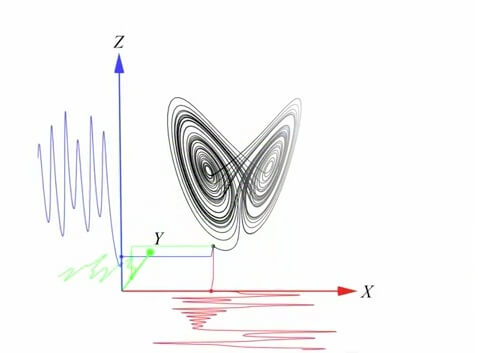
(b) Takens’ Theorem and Shadow Manifolds. http://youtu.be/rs3gYeZeJcw
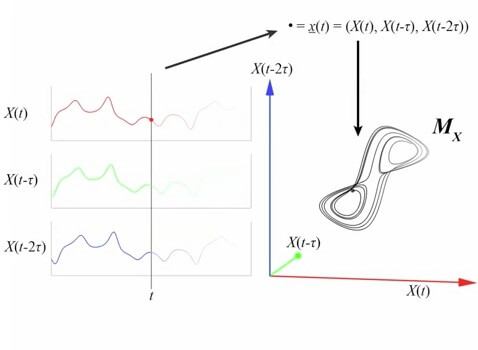
(c) Convergent Cross Mapping. http://youtu.be/NrFdIz-D2yM

Chih-hao Hsieh
http://homepage.ntu.edu.tw/~complex/ecoinformatics_c.html