A group of scientists from the Institute of Oceanography, National Taiwan University, led by Dr. Carmen García-Comas and Prof. Chih-hao Hsieh, demonstrate that the interaction of predator and prey size diversities affects trophic transfer efficiency in marine plankton. This is the first study to analyze individual size structure at two trophic levels in plankton, and proposes mechanisms to explain variation of trophic transfer efficiency at contrasting marine environments. Conclusions of this study support size as an important functional trait, and contribute to implement size-based plankton models. Their results are published in the Proceedings of the Royal Society of London B (February 2016).
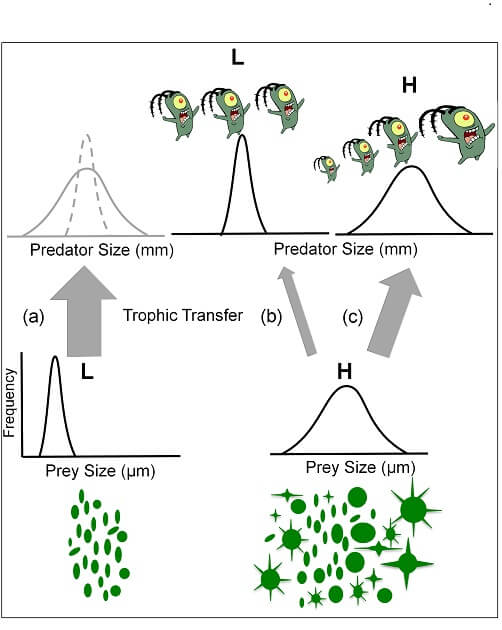
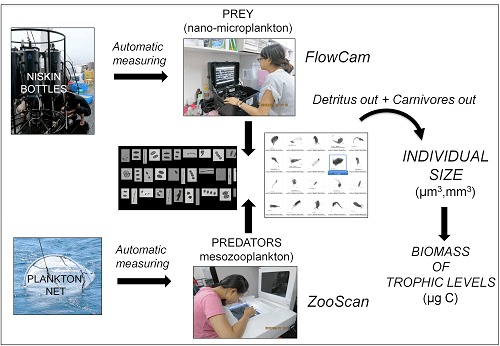
The amount of food available to socio-economically important animals such as fish is related to how efficiently zooplankton (predators) convert their food (small unicellular plankton as prey) into body mass. In this work, the team employed the well-established argument that size represents the most important functional trait in aquatic ecosystems. With two different imaging tools, they analyzed the size diversity of both plankton trophic levels in the East China Sea. They found that low prey size diversity facilitates trophic transfer, whereas high predator size diversity promotes it. More importantly, the effect of two trophic levels is interactive; that is, the positive effect of predator size diversity on trophic transfer is high especially when prey size diversity is also high. The team proposed the following mechanistic explanations: 1) low prey size diversity implies the dominance of small fast-growing cells that can support more zooplankton, and also implies less defenses against predation; and 2) high predator size diversity favors transfer efficiency, especially when size diversity of prey is high, because a greater variety of predator sizes can take better advantage of the available prey through diet niche partitioning.
This work is an outcome of the largest interdisciplinary ocean ecosystem research project in Taiwan: Effects of Global Change on Ocean Biogeochemistry and Ecosystems in the Seas surrounding Taiwan in the Northwest Pacific (ECOBEST)
Reference:
García-Comas, C., A. R. Sastri, L. Ye, C. Y. Chang, F. S. Lin, G. C. Gong, and C. H. Hsieh (2016) Predator size diversity promotes biomass trophic transfer and prey size diversity hinders it in planktonic communities. Proceedings of the Royal Society of London, Series B. 283: 20152129. http://rspb.royalsocietypublishing.org/content/283/1824/20152129.abstract |