
“A decade of sea level rise slowed by climate-driven hydrology“
J. T. Reager, A. S. Gardner, J. S. Famiglietti, D. N. Wiese, A. Eicker, M.-H. Lo.
While the ice sheets and mountain glaciers continue melting, changes in climate over the past decade have led to Earth’s continents to store an extra 3.2 trillion tons of water in land (over soils, lakes and underground aquifers), temporarily lowering the rate of sea level rise by about 20% that is called “climate-driven sea level changes”.
The climate-driven sea level rise has been absent from IPCC sea level budget owing to lacking of observations. Recent advances in satellite measurement of time-variable gravity combined with reconciled global glacier loss estimates enable a disaggregation of continental land mass changes and a quantification of this term. To illustrate the importance of including climate-driven changes in land water storage in decadal sea level budgets, we place our estimate of climate-driven land water storage uptake in the context of other mass contributions to sea level change as estimated by using GRACE data (Launched in 2002, NASA’s Gravity Recovery and Climate Experiment (or, GRACE) provided the land water storage trends by measuring the distance between the two GRACE satellites.).
Over the past decade, climate-driven land water storage uptake is of opposite sign and of magnitude comparable with ice losses from glaciers and ice sheets and nearly twice as large as mass losses from direct human-driven changes (groundwater withdrawal and dam) in land water storage. It is found that between 2002 and 2014, climate variability resulted in an additional 3200 ± 900 gigatons of water being stored on land. This gain partially offset water losses from ice sheets, glaciers, and groundwater pumping, slowing the rate of sea level rise by 0.71 ± 0.20 mm per year.
Our results show that climate-driven changes in land water storage are now observable on a global scale and that these changes are large and necessary for closure of decadal scale sea level budgets. These findings highlight the importance of climate-driven changes in hydrology when assigning attribution to decadal changes in sea level.
Reference:
J. T. Reager, A. S. Gardner, J. S. Famiglietti, D. N. Wiese, A. Eicker, M.-H. Lo. A decade of sea level rise slowed by climate-driven hydrology. Science, 2016 DOI: 10.1126/science.aad8386
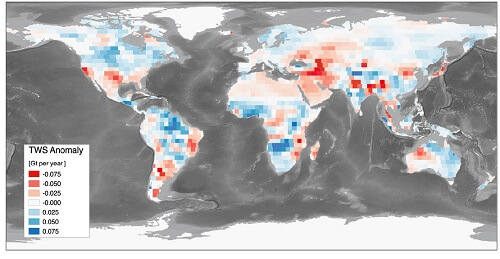
Fig. 1. Trends in land water storage from GRACE observations, April 2002 to November 2014. (Reager et al., 2106)
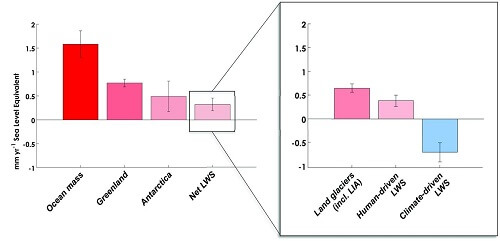
Fig. 2. Observed global mass contributions to SLR, 2002 to 2014, including the disaggregated land water storage term. (Reager et al., 2106)
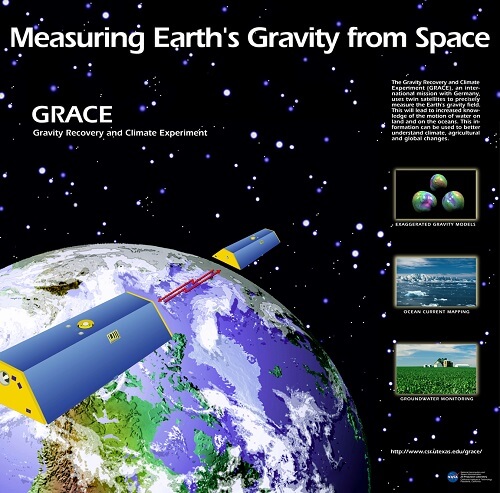
Fig. 3. Gravity Recovery and Climate Experiment, GRACE mission. (from JPL, NASA, http://gracetellus.jpl.nasa.gov/multimediagallery/ )