
“How much does groundwater contribute to sea level rise?“
Min-Hui Lo
Rising sea level is a threat to people who live near the coastal regions and in small islands; hence, accurately projecting rates of sea level rise is important, especially under climate changes. Recent assessments indicate that groundwater depletion (GWD) may become the most important positive terrestrial contribution. Future projections of increasing reliance on groundwater suggests that GWD will become the most important singular terrestrial contribution to sea level rise over the next 50 years, likely equal in magnitude to the current contributions from glaciers and ice caps. However, a critical common assumption of these existing estimates is that nearly 100% of groundwater extracted from aquifers ultimately ends up in the oceans. Due to limited knowledge on the pathways and mechanisms governing the ultimate fate of pumped groundwater, the relative fraction of global GWD that contributes to sea level rise remains unknown.
In this study, we present a coupled climate-hydrological model simulation to track the fate of water pumped from underground, and to estimate the portion of GWD contributing to sea level changes. Results show that when considering the land-atmosphere interactions from the groundwater withdrawal, the fraction of GWD that ends up in the ocean is only 80%. This indicates that existing studies have substantially overestimated the contribution of GWD to global SLR by a cumulative amount of at least 10 mm during the 20th century and early 21st century.
Previous studies, including estimates used in the IPCC Fifth Assessment Report, had assumed that nearly 100% of extracted groundwater ended up in the ocean. The new study improves on previous estimates by accounting for feedbacks between the land, ocean, and atmosphere. It finds that number is closer to 80%. That means that the gap between modeled and observed sea level rise is even wider, suggesting that other processes are contributing more water than previously estimated. These findings also highlight the importance of land-hydrological cycle and its interactions with climate when assigning attribution to changes in sea level.
Reference
Wada Y, Lo MH, Yeh PJF, Reager JT, Famiglietti JS, Wu RJ, Tseng YH (2016). Fate of water pumped from underground and contributions to sea-level rise. Nature Climate Change. doi:10.1038/NCLIMATE3001
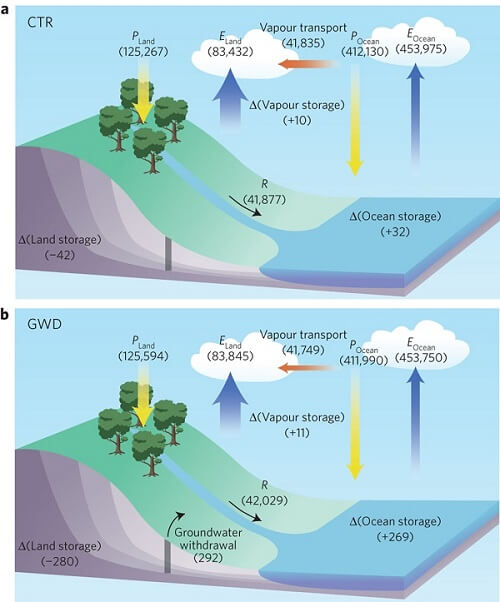
Figure 1. Schematic diagram of global water budget over the land and the ocean. The values (in km3 yr−1) show the long-term averages for a control (CTR) or natural run without pumping (a) and a GWD run with pumping (b) over the period 1900–1999.

Figure 2. Time series of the estimated annual contribution of terrestrial water storage change to global sea level over the period 1900–2010. To estimate the mean and standard deviation over the groundwater depletion estimates, we used the mean and standard deviation from groundwater recharge and pumping as parameters in an assumed Gaussian distribution and drew 100 realizations for each flux.