
Scientists of National Taiwan University develop a new ecological theory to use individual size distribution as biological indicators for foodweb complexity
“The big eat the small” is one of the most well-known ecological principles in aquatic ecosystems. Following this principle, together with energy loss during trophic transfer, a famous trophic pyramid is established; that is, the abundance of small organisms (e.g. small fishes) should be higher than that of large ones (e.g. large fishes). More specifically, the individual abundances decrease gradually as they increase their body size, and the rate of decline depends on how much energy loss due to organism’s metabolism. Such kind of abundance distribution of individual body size (ISD) is predicted to follows power-law distribution, according to the famous Metabolic Theory of Ecology. However, if big fish eat not only small fish but also more tiny shrimps, what would happen? An ecological research in Feitsui Reservoir points out that some macrozooplankton indeed eat not only microzooplankton but also tiny phytoplankton (omnivorous feeding); moreover, ultra-small unicellular ciliates eat flagellates or bacteria and become the top predator in microbial food web. These complex interactions are likely to be common in nature, but the metabolic theory has neglected these complexities through assuming a linear relationship between body size and trophic level.
To appreciate these natural variations in characterizing ecosystem properties, the associate professors, Chih-hao Hsieh and Takeshi Miki and their student, Chun-Wei Chang, of the Institute of Oceanography, National Taiwan University, developed a novel generalized metabolic theory that can accommodate the nonlinear relationship between body size and trophic level. This study has been published in Ecology in April, 2014. According to their theory, the ISD contains not only power-law distribution but also secondary structure. The secondary structure represents the deviation from the power law distribution; for example, the abundance of some large-sized individuals will be higher than that of small-sized individuals. In the past, the secondary structure, albeit commonly observed in nature, has been overlooked and invited no consistent explanation. However in their new findings, the team, for the first time, proposes the secondary structure is a consequence of complex food web interactions; that is, the ISD secondary structure arise when the linear relationship between body size and trophic level is violated (Figure 1). The team used automatic imaging systems to quantify individual size distribution and employed stable isotope analysis to quantify trophic interactions. Their theory successfully predicts the empirical plankton data in Feitsui Reservoir quantitatively. The findings have important management implications, because the secondary structure can be used to infer food web complexity. The food web complexity has been demonstrated to be an important property linking to the reliability of ecosystem functions; however, it is much more difficult to directly measure food web complexity than ISD. To this end, the ISD secondary structure can be a useful biological indicator to infer food web complexity in ecosystems, such as Feitsui Reservoir. For example, the study finds that the secondary structure becomes more apparent when the phytoplankton production is too high or too low in Feitsui Reservoir. Such kind of information can be used for monitoring and management of the reservoir.
Reference
Chang C. W., T. Miki, F. K. Shiah, S. J. Kao, J. T. Wu, A. R. Sastri, and C. H. Hsieh (2014) Linking secondary structure of individual size distribution with nonlinear size-trophic level relationship in food webs. Ecology. 95: 897-909.
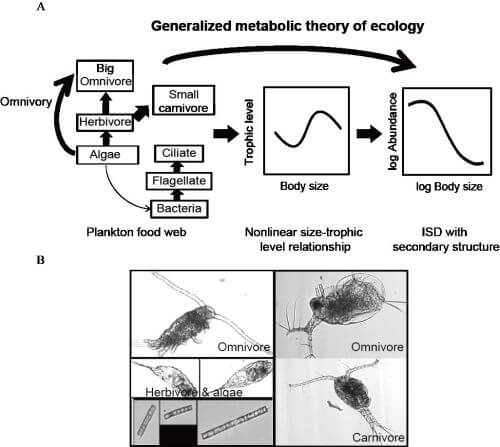
Figure 1. A) Food web with complex feeding interactions, such as omnivory and microbial trophic interaction may create nonlinear size-trophic level relationship. The nonlinearity in size-TL relationship induces the secondary structure of individual size distribution (ISD), which is the nonlinear structure of ISD in log space. B) The images of plankton in Feitsui Reservoir, Taiwan.